Existing project onboarding
You have a real codebase with real history. This guide adds ndx without touching your code, gets a baseline of architectural findings, lets you triage them, sets up .gitignore so ephemeral state stays out of git, and then generates a PRD scoped to what actually matters — instead of bulk-importing every finding into a noisy backlog.
Starting from scratch?
If your project is brand new or empty, use the Quickstart instead. It's the same flow without the cleanup pass.
Prerequisites
- Node.js ≥ 22 (22 LTS)
- pnpm ≥ 10 — install pnpm
- A clean working tree. Commit or stash any in-progress work first —
ndx initwrites new files at the repo root and inside a few dot-directories.
1. Install
pnpm add -g @n-dx/core2. Initialize — but don't commit yet
ndx init .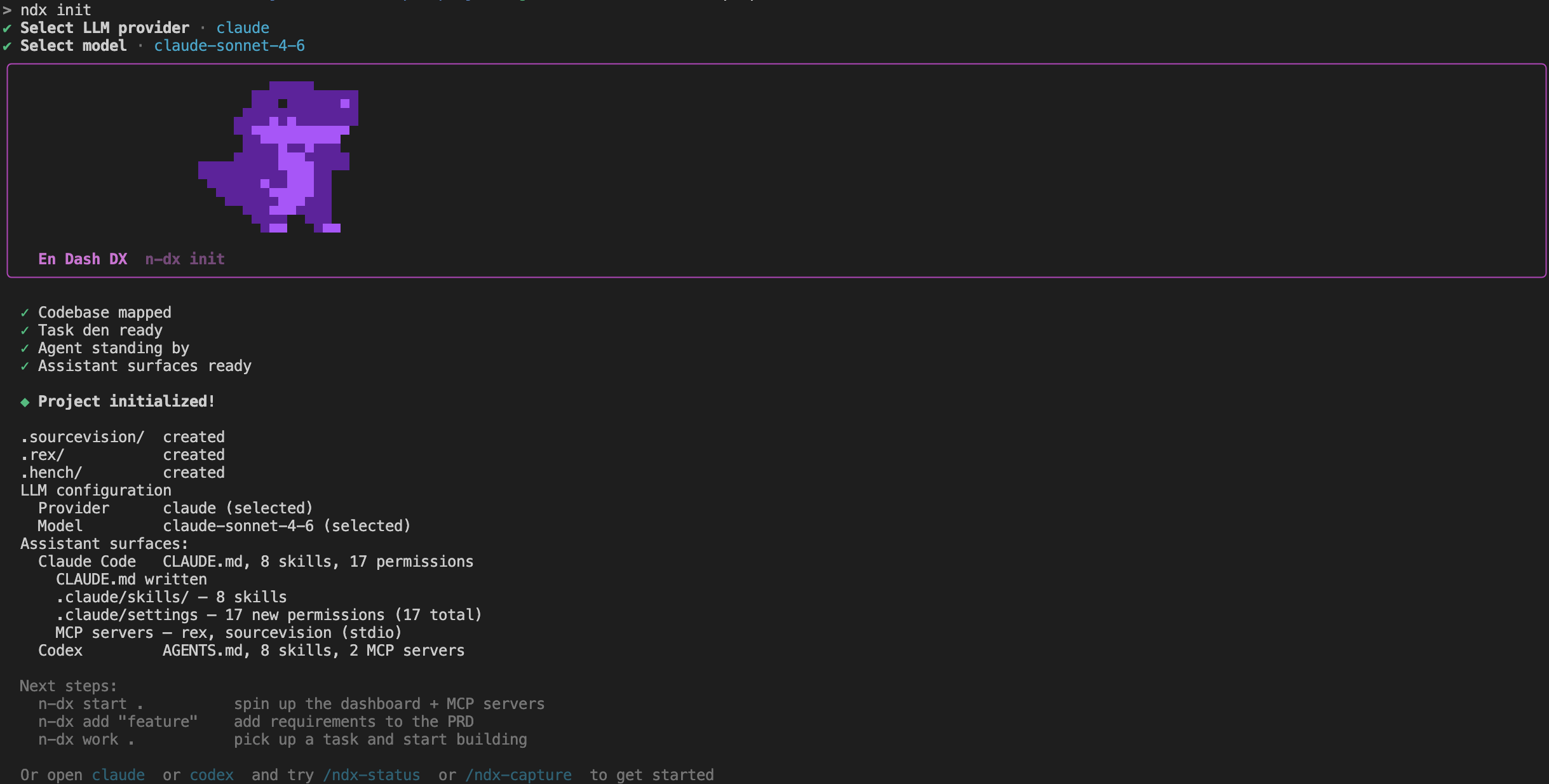
You'll be asked to choose an LLM provider (Claude or Codex). By default both surfaces are provisioned. Use --claude-only or --codex-only to limit to one assistant.
Init creates analysis metadata, PRD storage, agent configuration, and assistant-specific artifacts:
- Claude:
CLAUDE.md,.claude/skills/,.claude/settings.local.json, MCP server registration - Codex:
AGENTS.md,.agents/skills/,.codex/config.toml
Init also adds .n-dx.local.json to your .gitignore automatically — but that's the only ndx path it gitignores. The rest you'll add yourself in Step 4 before any commit.
Don't commit yet
Resist the urge to git add . here. Several files ndx just produced are ephemeral or local-only. Commit after Step 4.
3. Pre-flight analysis (read-only)
Get an architectural baseline before ndx writes anything to your PRD:
ndx analyze .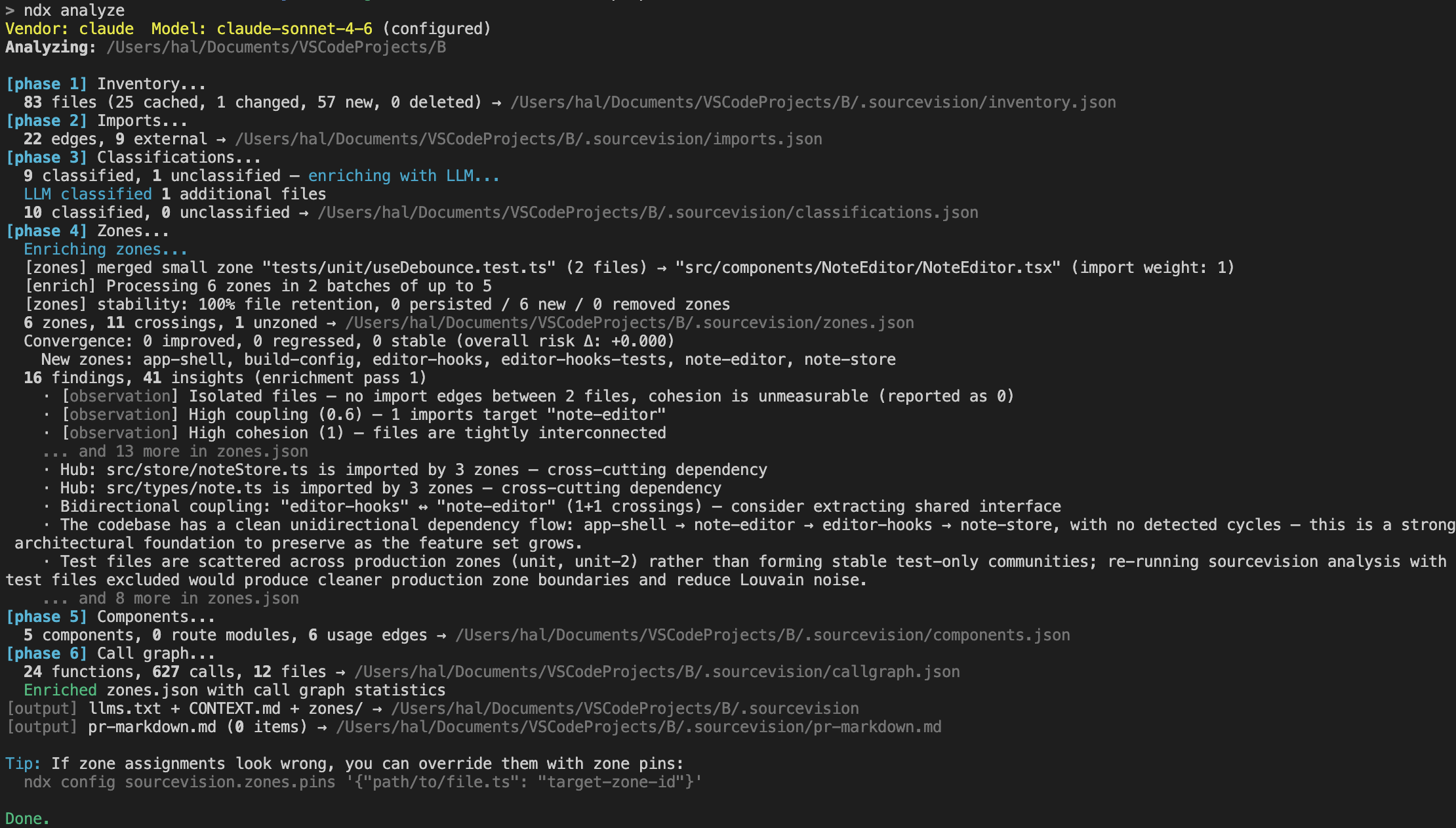
Analyze writes only to .sourcevision/ — file inventory, import graph, zones, findings. No PRD changes yet. Then read what it found:
ndx recommend --actionable-only .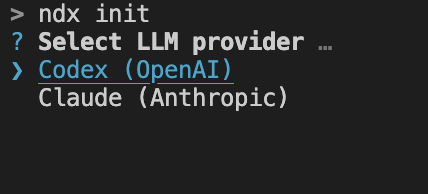
Skim .sourcevision/CONTEXT.md for the AI-readable summary, and use the recommend output to see what ndx thinks needs work. The goal here is a mental model — you don't need to act on anything yet.
4. .gitignore basics
Do this before your first ndx-related commit. Without these entries, ephemeral runs, locks, caches, and PID files will end up in version control and create noise on every diff.
See .gitignore for ndx projects for the full reference — what each path contains and why it should be ignored. The copy-pasteable snippet from that page:
# n-dx — runtime artifacts and ephemeral state
# Keep: .rex/prd_tree/ .rex/config.json .hench/config.json CLAUDE.md AGENTS.md
# Optional: .sourcevision/ (shared analysis baseline) .n-dx.json (project config)

# Analysis output (regenerated by `ndx analyze`)
.sourcevision/

# Agent runs, locks, and session state
.hench/runs/
.hench/locks/
.hench-commit-msg.txt

# Rex ephemeral state
.rex/.backups/
.rex/.cache/
.rex/prd.json.lock
.rex/pending-proposals.json
.rex/acknowledged-findings.json
.rex/execution-log*.jsonl
.rex/adapters.json
.rex/n-dx_workflow.md

# Server runtime
.n-dx-web.pid
.n-dx-web.port

# Run logs
.run-logs/

# Local config overrides (may contain secrets or API keys)
.n-dx.local.json
*.local.json

# Assistant local settings (personal, not shared)
.claude/settings.local.json
If you want to commit .sourcevision/ as a shared analysis baseline (so teammates skip a re-analysis pass), remove that line. See the gitignore guide for the full commit/ignore decision table.
Now run git status to confirm only the files you want are staged, then commit the init baseline (without a PRD yet):
git add .gitignore .sourcevision/ .rex/config.json .hench/config.json CLAUDE.md AGENTS.md
git commit -m "chore: add n-dx baseline (sourcevision + config)"
5. Pre-emptive self-heal (optional, recommended for older repos)
A self-heal pass before PRD generation lets ndx fix the mechanical findings it already knows how to fix — circular dependencies, unused exports, simple anti-patterns — so your PRD doesn't fill up with grunt work.
ndx self-heal 1 . --yes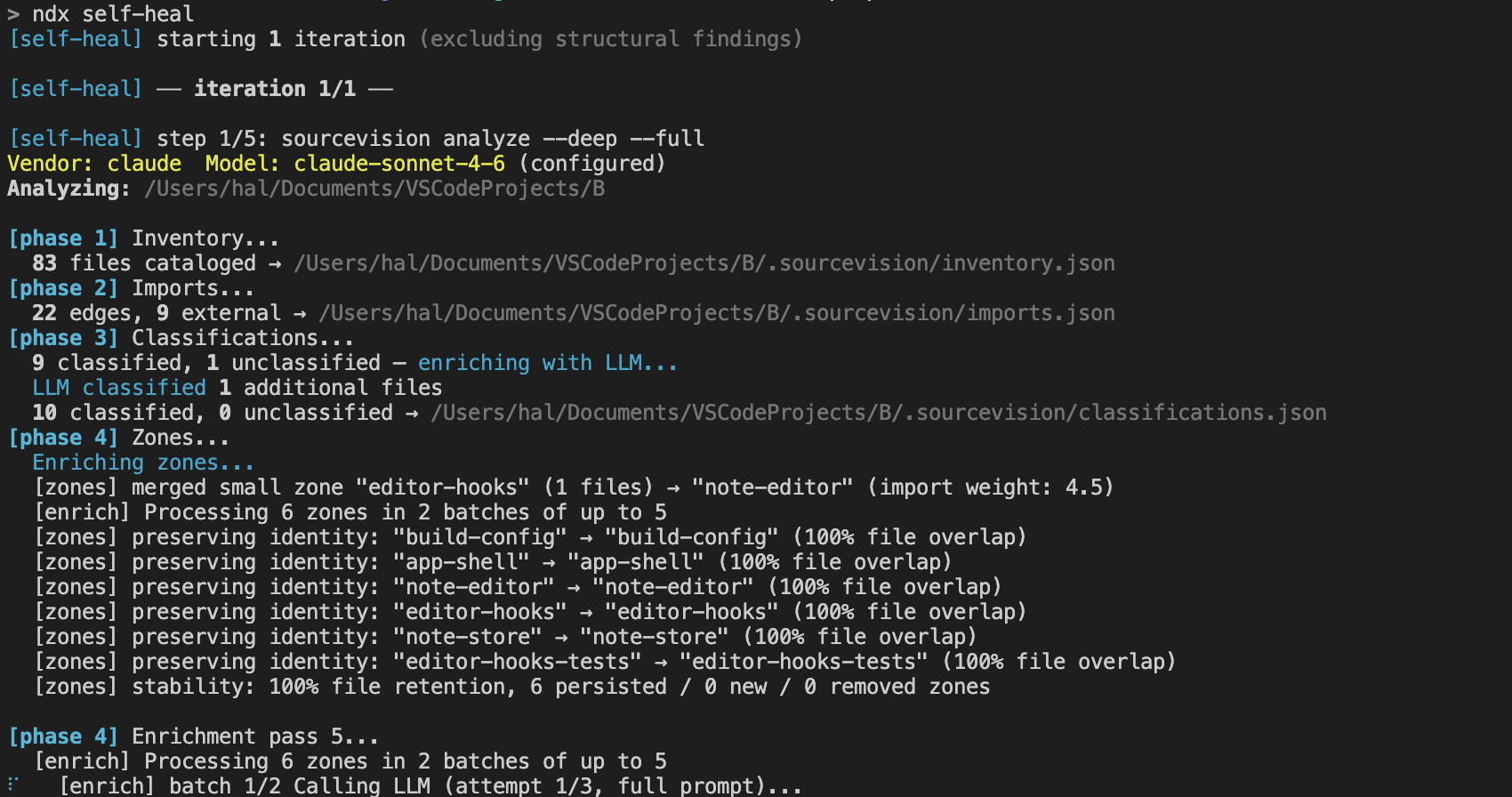
The argument (1) is the iteration count. Each iteration runs analyze → recommend → accept → execute → acknowledge, and a regression guard aborts the loop if circular deps or total code-health issues increase. For a deeper pass:
ndx self-heal 3 .When to skip this step:
- The repo is small or the findings list is already tiny
- You want to review every code change manually before it lands
When to go further instead:
- The codebase is genuinely messy or prototype-quality → see Cleaning Up a Vibe-Coded App for a heavier remediation flow
6. Triage findings before generating the PRD
Acknowledge findings you don't intend to fix — intentional architectural choices, work that's already on someone else's plate, or anything outside your team's scope. Acknowledged findings persist in .rex/acknowledged-findings.json (gitignored — these are personal triage notes) and won't regenerate on the next analyze.
ndx recommend --actionable-only --acknowledge .For the lifecycle details (fuzzy matching, regeneration rules, un-acknowledging), see Self-Heal Loop.
7. Generate the PRD — review, don't blanket-accept
ndx plan .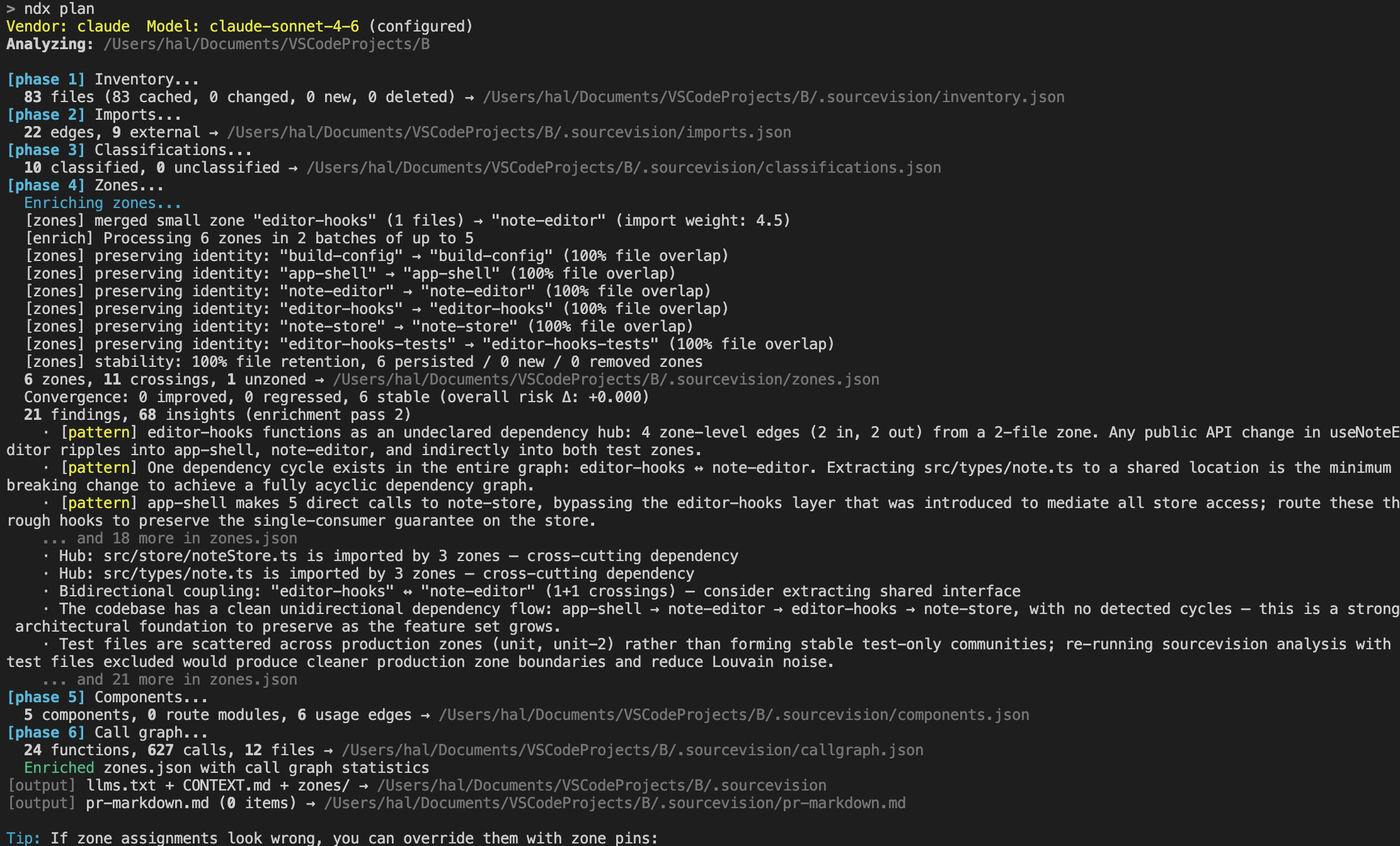
Do not pass --accept here. The blank-project Quickstart uses --accept because there's no existing context to filter against; on an existing repo it's a recipe for a noisy backlog. The default flow is interactive — review each proposal and accept only what fits your roadmap. Anything you don't review is cached in .rex/pending-proposals.json and you can revisit it later with rex analyze --accept.
The accepted items land in .rex/prd_tree/ as a slug-named folder hierarchy (one directory per epic/feature/task, each with an index.md).
8. Validate and commit the PRD baseline
ndx ci .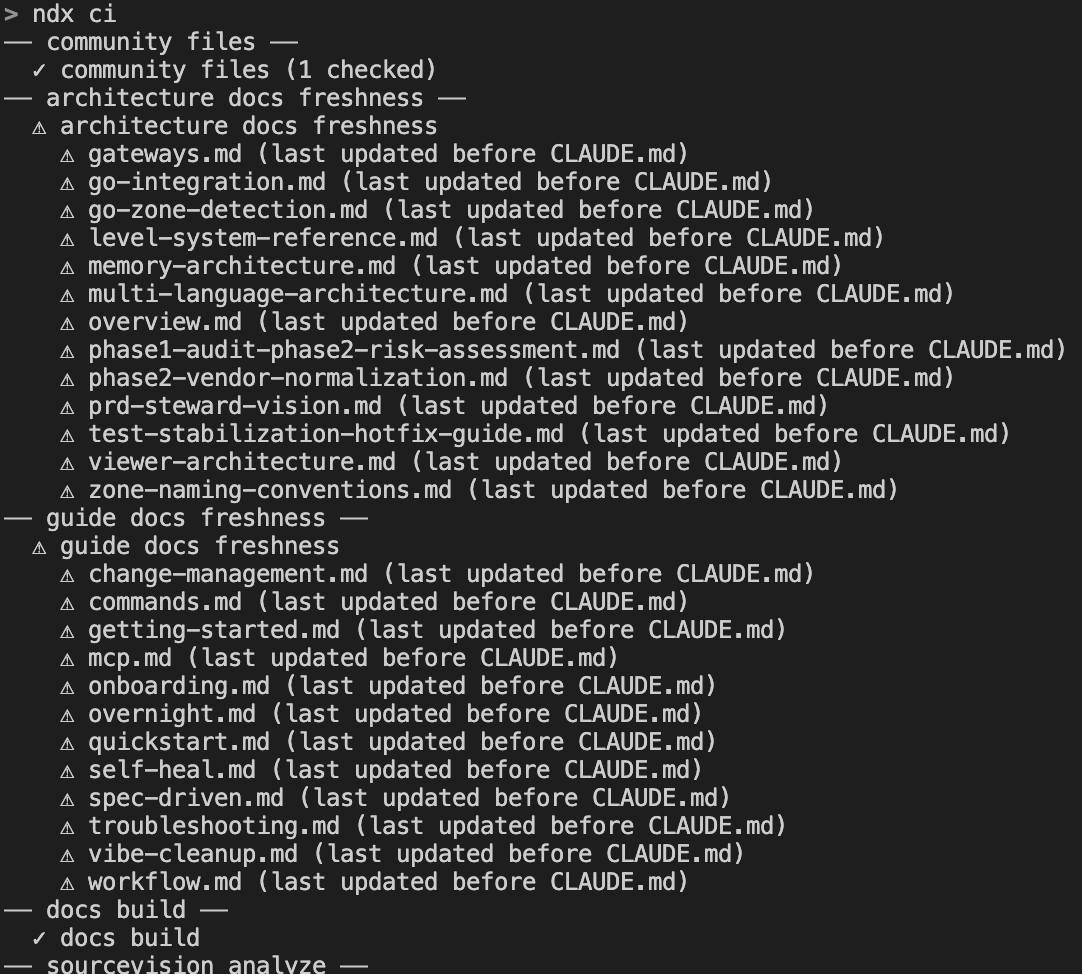
ndx ci runs the docs, analysis, health, and PRD validation phases. A green run is a good signal that your integration is consistent — use it as the commit point for your initial PRD:
git add .rex/prd_tree/ .sourcevision/
git commit -m "chore: integrate n-dx (initial PRD + analysis baseline)"
9. Start the dashboard and hand off to the team
ndx start .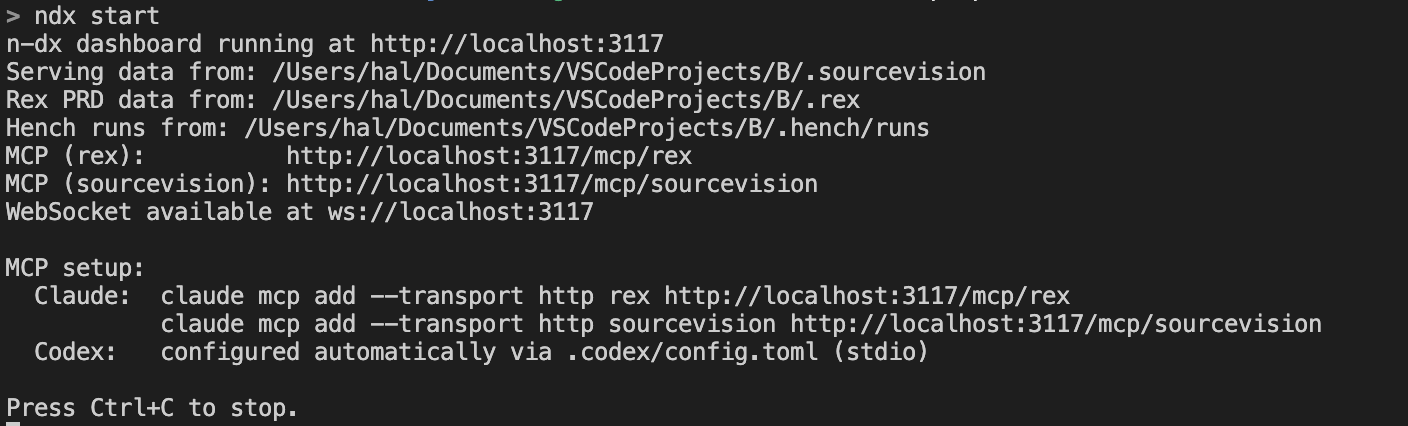
The dashboard runs at http://localhost:3117 with interactive views of zones, PRD tree, and agent runs.
For teammates: after they pull the repo, they only need pnpm add -g @n-dx/core and ndx start . — no re-analysis, no re-init. The committed .sourcevision/ and .rex/prd_tree/ give them the same baseline you just built.
What's next?
- Build a mental model of the codebase: Codebase Onboarding — using MCP tools and the dashboard to explore zones interactively
- Heavier cleanup pass: Cleaning Up a Vibe-Coded App — when the repo needs more than one self-heal iteration
- Keep the PRD aligned over time: Change Management — drift detection, post-sprint pruning, sync with external trackers
- The self-heal loop in depth: Self-Heal Loop — finding lifecycle, fuzzy acknowledgment, regression guards
- All commands and flags: Commands
- Day-to-day workflow: Workflow
Skills used in this guide
Each skill below maps to a step in this guide. Edit the linked file in your project to customize that step's behavior in your assistant session.
| Skill | Source | Role in this guide |
|---|---|---|
/ndx-zone | .agents/skills/ndx-zone/SKILL.md | Step 3: explores zone health metrics from the pre-flight analysis to identify highest-risk areas |
/ndx-plan | .agents/skills/ndx-plan/SKILL.md | Step 7: generates the initial PRD interactively, filtered by the findings you triaged in Step 6 |
/ndx-status | .agents/skills/ndx-status/SKILL.md | Step 8: confirms PRD integrity after acceptance and before the first commit |
/ndx-config | .agents/skills/ndx-config/SKILL.md | LLM setup: sets vendor, API key, model, and CLI path during init |
/ndx-work | .agents/skills/ndx-work/SKILL.md | Post-onboarding: executes the first tasks from the accepted PRD |
Related guides: Codebase Onboarding (interactive zone exploration after the baseline is committed), Cleaning Up a Vibe-Coded App (heavier remediation when pre-flight findings are extensive), Change Management (keeping the PRD aligned over time), n-dx vs Spec Kit (how n-dx differs from Spec Kit, OpenSpec, and Kiro).
For the full skill inventory and customization guidance, see the Skills Reference.